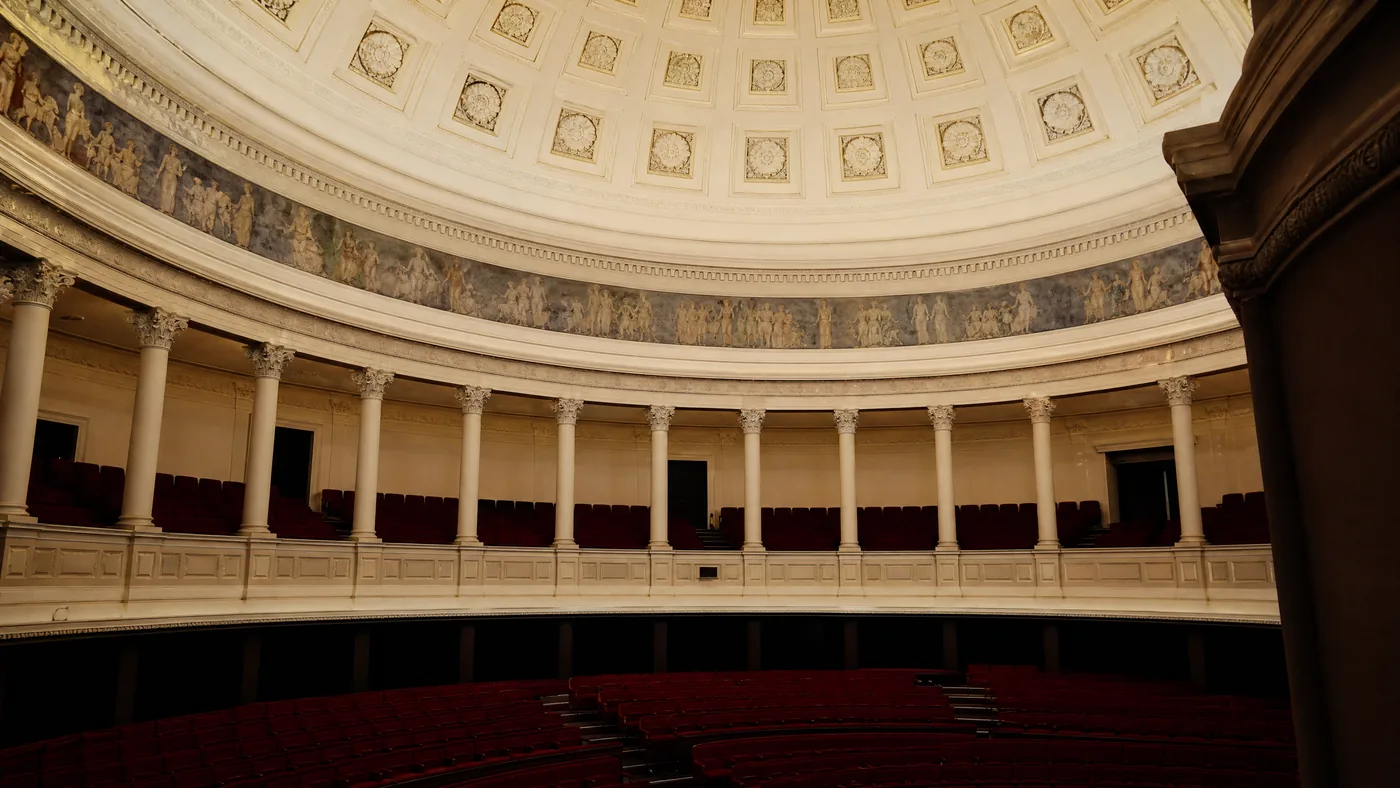
Booking choice: The communism walking tour, from $23 per person. Check dates Tour details
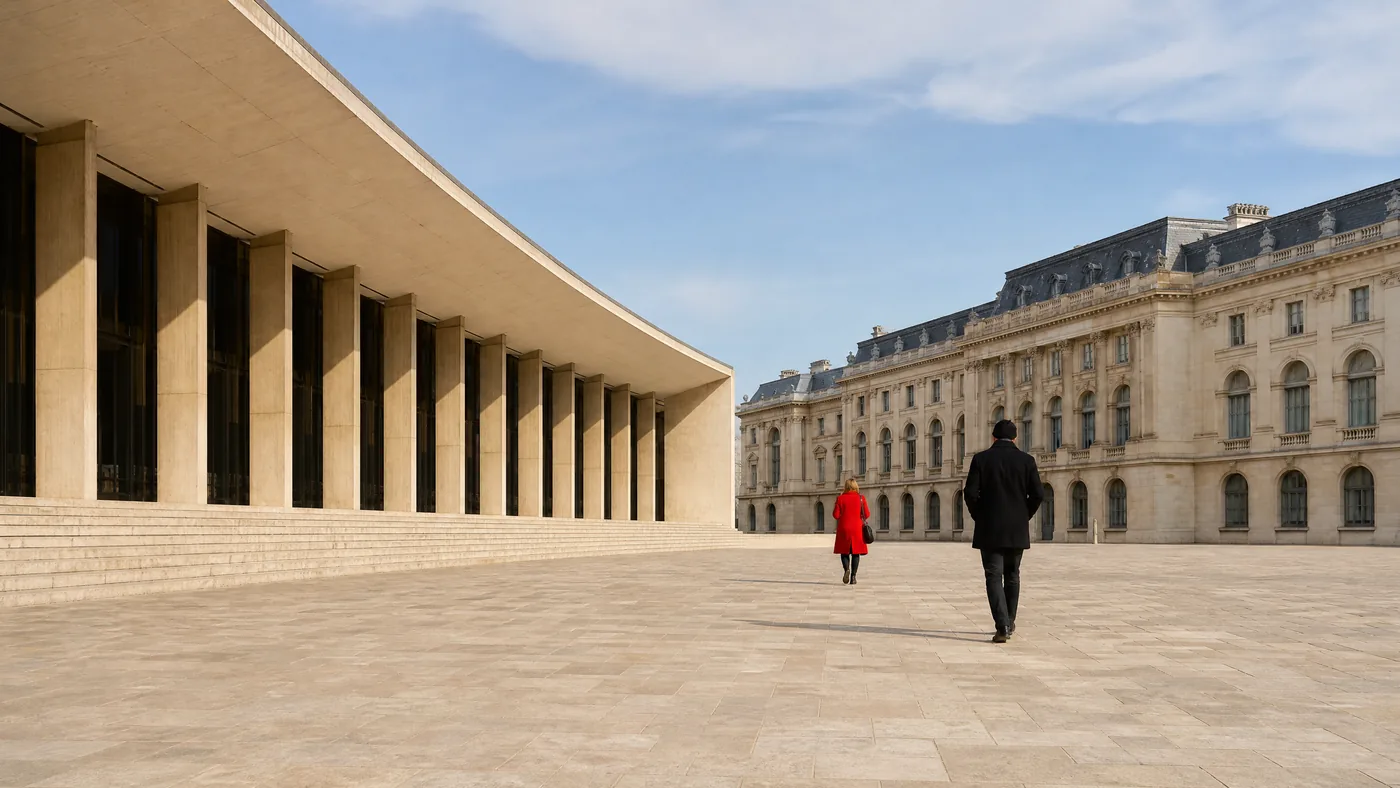
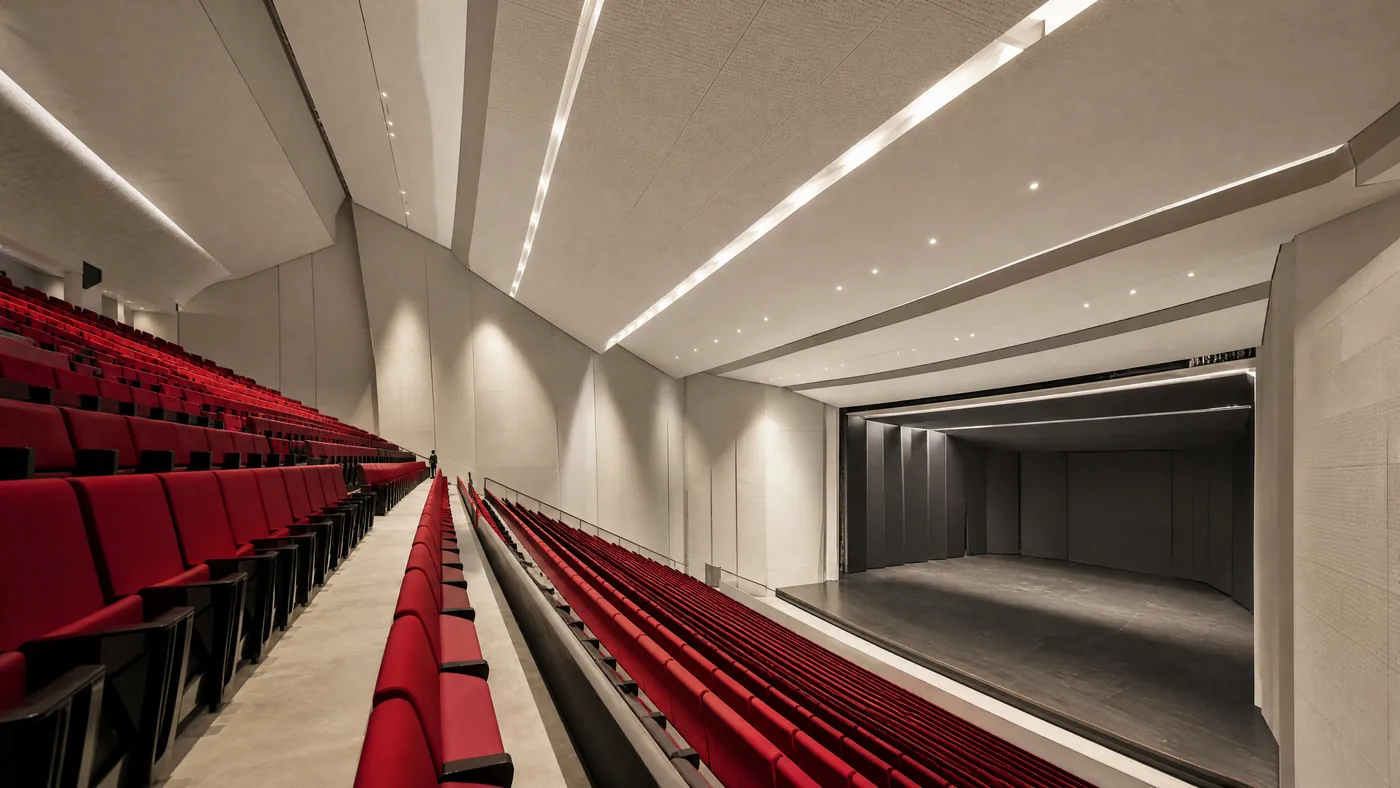
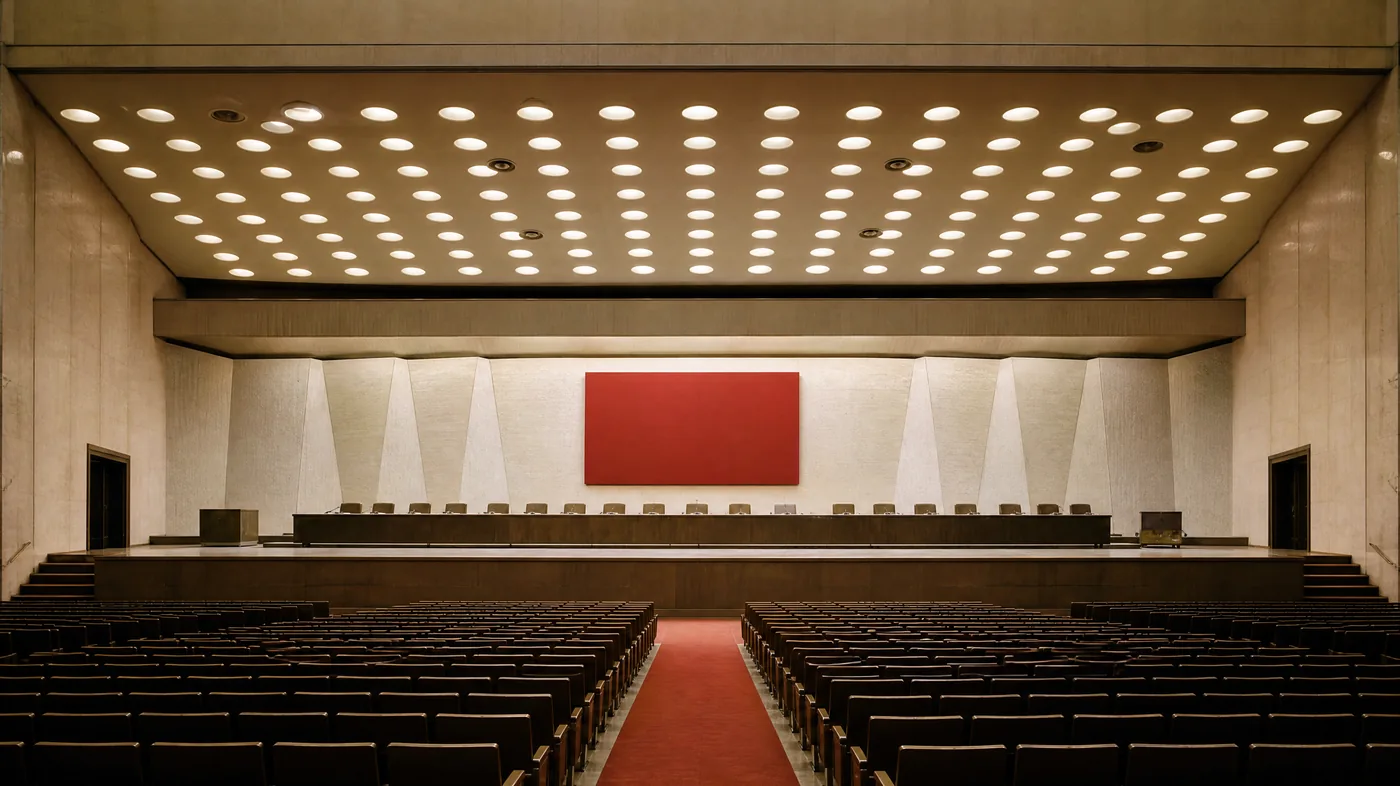
The building behind the former Royal Palace on Revolution Square looks like nothing else in central Bucharest. A curved, concave roof sits over a long front of stone and glass. Inside is an amphitheater for 4,060 people that was designed for speeches, votes and standing ovations, and now hosts Christmas concerts, stand-up comedy and the George Enescu Festival.
This guide follows the hall from the royal villa that stood on the site to the 1982 enlargement under Nicolae Ceaușescu, the world conferences, the concerts since 1990 and the renovation plan reported in the press. A timeline comes first, then the details, each with its sources.
The quick answer
Sala Palatului was built from January 1959 to April 1960 for the 3rd Congress of the Romanian Workers' Party, on the site of the royal villa Casa Nouă. It opened with about 3,150 seats, was enlarged to over 4,000 in 1982 on Ceaușescu's orders and now seats 4,060. Since 1990 it has been Bucharest's main stage for big concerts and the George Enescu Festival.
When was Sala Palatului built?
From January 1959 to April 1960, in 15 months, during the Gheorghiu-Dej regime. It opened in 1960 for the 3rd Congress of the Romanian Workers' Party.
In Your Pocket gives the build as 15 months, from January 1959 to April 1960. The hall's own history page simply says it was inaugurated in 1960. Romanian Wikipedia ties it to the 3rd Congress of the party, then called the Romanian Workers' Party, under Gheorghe Gheorghiu-Dej. That congress ran from 20 to 25 June 1960, and Nikita Khrushchev led the Soviet delegation.
The hall was built as an extension of the Royal Palace and is connected to it, In Your Pocket notes. That is why the name means the Palace Hall.
| Year | What happened | Source |
|---|---|---|
| 1944 | Casa Nouă, the royal villa on the site, is bombed and destroyed on 24 August | Wikipedia |
| 1948 | The Royal Palace in front becomes the Palace of the Republic | Wikipedia |
| 1959 to 1960 | Sala Palatului is built in 15 months, January to April | In Your Pocket |
| 1960 | Inaugurated; the party congress meets in June | salapalatului.ro; Wikipedia |
| 1961 | First George Enescu Festival in the Grand Hall of the Palace | Wikipedia |
| 1974 | The UN World Population Conference meets in Bucharest | United Nations |
| 1982 | Ceaușescu has the hall enlarged to over 4,000 seats | Romanian Wikipedia |
| 1989 | The party's 14th Congress, 20 to 24 November | Radio Romania International |
| 1990 onward | Concerts, shows and festivals become the main business | Wikipedia |
| 2018 | A renovation of about EUR 30 million is reported | Romania Insider |
| 2025 | 27 concerts of the Enescu Festival, 16 orchestras | George Enescu Festival |
Who designed Sala Palatului?
Horia Maicu, Tiberiu Ricci and Ignace Șerban, with Romeo Ștefan Belea in the team, plus engineers for the structure, the acoustics and the lighting.
Wikipedia names three architects: Horia Maicu, Tiberiu Ricci and Ignace Șerban. Europa Liberă Romania calls Maicu the chief architect and says Ricci led the design team. In Your Pocket credits the design to Ricci, who was also behind the building of TVR, the national television. Romanian Wikipedia adds the architect Romeo Ștefan Belea and lists the engineers by trade.
| Role | Names | Source |
|---|---|---|
| Architects | Horia Maicu, Tiberiu Ricci, Ignace Șerban | Wikipedia EN and RO |
| Architect in the team | Romeo Ștefan Belea | Romanian Wikipedia |
| Structure | A. Cișmigiu and D. Badea | Romanian Wikipedia |
| Acoustics | Alexandru Anton Necșulea and N. Wegener | Romanian Wikipedia |
| Electrical and lighting | A. Băilescu and V. Marinescu | Romanian Wikipedia |
The look is what stops people on the square. Wikipedia files the building as modernist, and In Your Pocket singles out its concave roof, a long curve that dips toward the middle. Next to the classical Royal Palace and the domed Athenaeum, it reads like a statement of the new regime in stone and glass.
What stood on the site before Sala Palatului?
Casa Nouă, the villa where the royal family lived, destroyed by German bombing on 24 August 1944. A 17th-century church was also demolished for the hall and the blocks opposite.
Behind the Royal Palace stood Casa Nouă, the New House. Wikipedia describes it as the place where the royal family actually lived in Bucharest, since the palace held mostly official rooms. King Carol II's family lived there from 1930 to 1940.
It was the stage for one of the turning points of the Second World War. On the afternoon of 23 August 1944, during King Michael's coup, Marshal Ion Antonescu was arrested in the house after refusing to switch Romania to the Allied side. The next day a German Luftwaffe raid destroyed Casa Nouă and badly damaged the palace.
The communist rebuilding took more. In Your Pocket says a 17th-century church was demolished to make way for the hall and for the apartment blocks opposite, the first of many churches lost as central Bucharest was remodeled. The palace itself became the Palace of the Republic in 1948 and has housed the national art museum since 1950.
The communism walking tour covers about 15 stops on the regime's story, from nationalization to the demolitions, and ends on Revolution Square.
Check dates for the communism walking tourWhat is the Piața Sălii Palatului ensemble?
The Palace Hall Square: the hall and nine other buildings, mostly apartment blocks, planned as one ensemble in the same years.
Sala Palatului was never meant to stand alone. Wikipedia describes it as part of an ensemble of ten buildings called Piața Sălii Palatului, the Palace Hall Square. The blocks opposite the hall are the ones In Your Pocket mentions, built on ground that had been cleared for the project.
A postcard of the square from around 1960 to 1965, catalogued by the Photo Past Future archive, credits the project to Horia Maicu, Tiberiu Ricci, Ignace Șerban, Tiberiu Niga, Leon Garcia and G. Filipeanu. It shows the hall, the blocks, a small park and the square between them.
Opinion on the blocks is still split. In 2022 the Romanian outlet PressOne ran the question as its headline: a symbol of sad memory, or a historic monument? The hall itself is already a listed historic monument, code B-II-m-B-18423.
Two or three hours on life under the regime: nationalization, the Secret Police, the demolitions and the days of the revolution, ending on Revolution Square.
Explore the communism walking tour Tour detailsWhy was Sala Palatului enlarged in 1982?
Ceaușescu wanted more seats. The hall opened with about 3,150 and was enlarged to over 4,000 in 1982; today it seats 4,060.
Romanian Wikipedia gives 3,150 seats at the opening and says Nicolae Ceaușescu ordered the capacity raised to over 4,000 in 1982. Romania Insider rounds the first figure to 3,000. Romeo Belea, one of the hall's architects, told Europa Liberă Romania that he added galleries and extra exits to make room for the larger audience.
The reason was the congresses. In Your Pocket says the main auditorium was first used for the five-yearly congress of the party, and Romania Insider says the party kept holding them here. The last one, the 14th Congress, ran from 20 to 24 November 1989, Radio Romania International records, a month before the revolution. Europa Liberă Romania says the hall's last major renovation was done before that congress.
| Feature | Figure | Source |
|---|---|---|
| Seats in the Sala Mare | 4,060, in an amphitheater | salapalatului.ro |
| Height difference, front to back | Up to 12 m | salapalatului.ro |
| Air volume | About 30,000 cubic meters, 7.5 per spectator | salapalatului.ro |
| Stage | 20 m wide, 15 m deep; 28 m wide with the orchestra pit | salapalatului.ro |
| Simultaneous translation | 6 languages | salapalatului.ro |
| Foyer | 2,000 square meters, used for exhibitions | Wikipedia |
| Small conference rooms | 8, for 20 to 100 people | Wikipedia |
Which international conferences has Sala Palatului hosted?
The UN Economic Commission for Europe, the World Population Conference, the World Energy Congress and the World Congress of the Red Cross, among others.
The translation booths for six languages were not for show. Wikipedia lists four big international meetings at the hall: a conference of the United Nations Economic Commission for Europe, the World Population Conference, the World Energy Congress and the World Congress of the Red Cross.
The best known is the population conference. The United Nations dates it to 19 to 30 August 1974 in Bucharest, with representatives from 135 countries, and it adopted the World Population Plan of Action.
Between the big meetings the foyer filled with trade and art shows. The hall says it has held more than 60 exhibitions with 300,000 visitors, and it still rents its eight small rooms for meetings and press conferences.
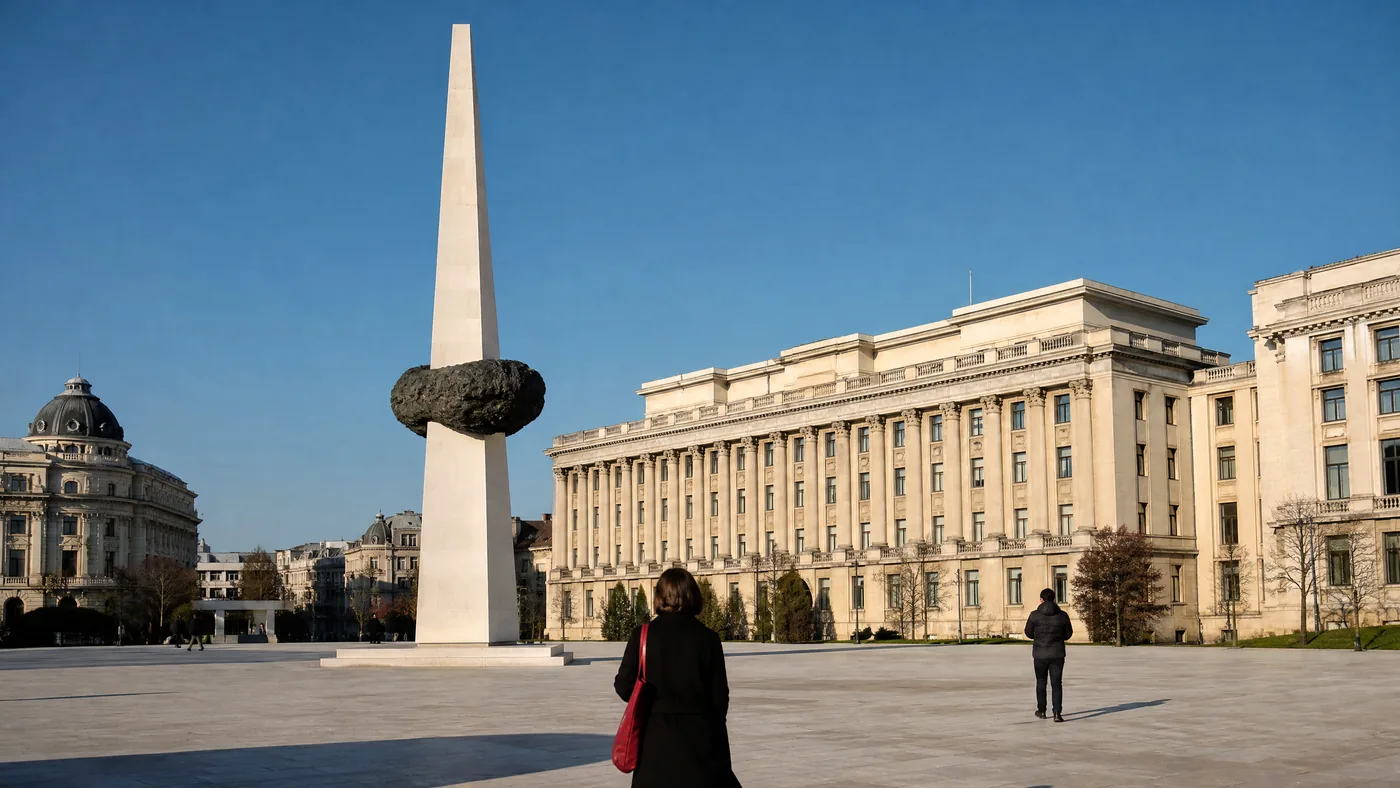
The off-the-path communism walk meets on Revolution Square and lists Sala Palatului among its stops, seen from outside.
Check dates for the off-the-path communism walkWho has performed at Sala Palatului since 1990?
The George Enescu Festival's great orchestras, and pop, rock and jazz names from Tom Jones and Mark Knopfler to José Carreras, Yanni and Romanian stars.
Concerts came early. Wikipedia's history of the George Enescu Festival says the 1961 edition was the first in the Grand Hall of the Palace, and in 1970 the London Symphony Orchestra found even that stage too small. In 2007 the festival closed with Carl Orff's Carmina Burana before more than 4,000 people.
After 1990 the hall turned to music full time. Wikipedia keeps a list of the acts of a few busy years:
| Year | Some of the names (Wikipedia list) |
|---|---|
| 2011 | Tom Jones, Engelbert Humperdinck, Nana Mouskouri, Elvis Costello, Pat Metheny, Bryan Ferry, Gipsy Kings, Manu Chao |
| 2012 | José Carreras, Steve Vai, Status Quo, Chick Corea, Nigel Kennedy, Bonnie Tyler, Ștefan Bănică Jr., Voltaj |
| 2013 | Mark Knopfler, Yanni, Smokie, Slash with Myles Kennedy |
| 2014 | Mireille Mathieu |
| 2015 | Pavel Stratan |
| 2025 | The Enescu Festival's 27-concert series with 16 orchestras |
The habit continues. The hall's calendar for this winter has Andra's Christmas show Vestire on 11, 12 and 13 December 2026, Voltaj on 8 December, a Nutcracker on 30 November, and Goran Bregovic, Richard Clayderman and Sandra in early 2027. Our post on what's on at Sala Palatului has the full list.
Will Sala Palatului be renovated?
A renovation of about EUR 30 million was reported in 2018, but no works have started. The hall stays open with a full calendar.
The plan has changed hands several times. Romania Insider reported in 2018 that the Ministry of Culture would take over the hall from RA-APPS, the state protocol estate, and renovate it for about EUR 30 million from a Council of Europe Development Bank loan. The same report notes an earlier round trip: the hall moved to the ministry in 2006 and back to RA-APPS six years later.
Later in 2018 the direction reversed again. Agerpres reported that the Senate approved moving the building back to RA-APPS, citing its need for consolidation, so the state company could run the works once funding was found.
The push comes from musicians. In 2011 Zubin Mehta, Daniel Barenboim and Valery Gergiev signed an open letter asking for a hall fit for the great orchestras, and Belea has said the room was built for speeches. In August 2025 Europa Liberă Romania reported only routine repairs since 1989 and no funded project; for that year's festival the hall used temporary acoustic panels and 3,000 seats. We give no date for works because none has been announced.
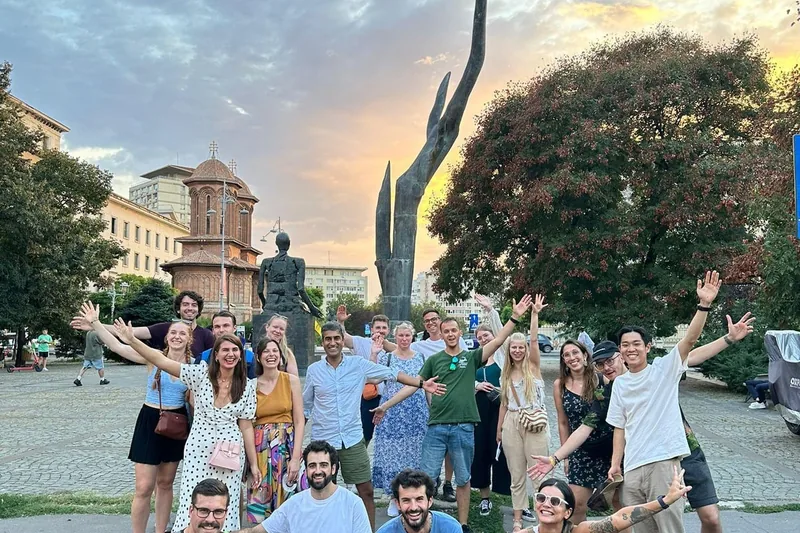
Two and a half hours from Revolution Square past the former Securitate headquarters and Sala Palatului to Cișmigiu and the Palace of Parliament, on everyday life under communism.
Explore the off-the-path communism walk Tour detailsFrequently asked questions
When was Sala Palatului built?
From January 1959 to April 1960, in 15 months, according to In Your Pocket. It was inaugurated in 1960 for the 3rd Congress of the Romanian Workers' Party.
How many seats did Sala Palatului have originally?
About 3,150, according to Romanian Wikipedia. Nicolae Ceaușescu had it enlarged to over 4,000 in 1982, and the main hall seats 4,060 today.
Who designed Sala Palatului?
The architects Horia Maicu, Tiberiu Ricci and Ignace Șerban, with Romeo Ștefan Belea in the team. Maicu was the chief architect.
Can you tour inside Sala Palatului?
There are no public tours inside; you see the auditorium with a concert ticket. Walking tours tell its story from outside, and the off-the-path communism walk lists the hall as a stop.
Ready to book
Choose your tour
Free cancellation up to 24 hours before on every option. Prices are from-prices in USD and move with the season.
Bucharest Communism Walking Tour
- Guided walking tour
- About 15 stops
- Communist-era snack on the 3-hour version
Bucharest Under Communism Walking Tour
Everyday life under the regime, from the square past the hall
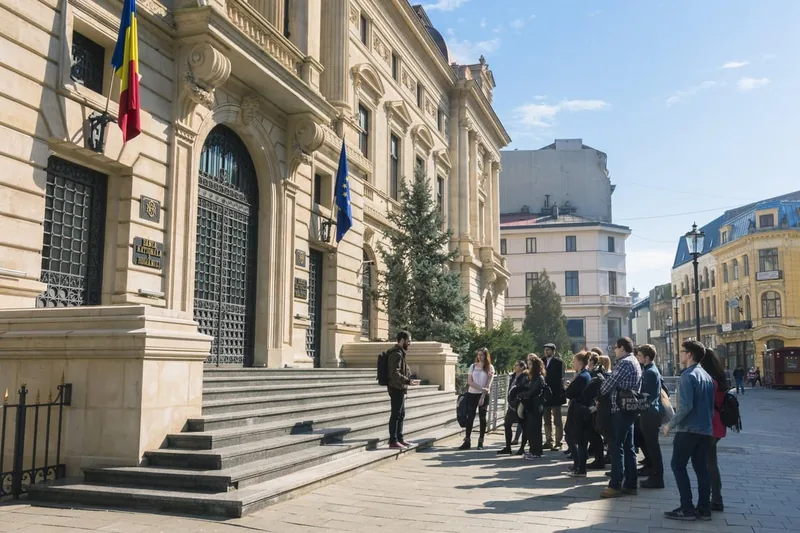
Old Town, Calea Victoriei and Communism Tour
- Professional local guide
- Map of Bucharest
- Revolution Square and Calea Victoriei